
Resource Review: The Biggest Story - Student Workbook
Bringing It Home
We often think of kids ministry curriculum as something that lives at church. Sure, parents may get a take home card, or a link to a devo to circle back to during the week, but most of the work of a curriculum happens within the Sunday School classroom. What if I told you that there was a way to bring the depth, structure, and ease of use of a complete kids ministry curriculum and distill it into a single volume you could use at home with your family? Pretty cool, right?
That’s exactly what Crossway has built with the Student Workbook for their The Biggest Story curriculum that launched this summer. It’s got all the things you love from The Biggest Story as a kids minister or parent (and there’s LOTS to love!), but it’s been designed from the beginning with families in mind. This single volume is your one-stop shop for helping your elementary-aged kids dive into more than 100 Bible stories (enough to cover two years if you hit one lesson each week!). Let’s jump in, and see what they’ve put together.
Digging In
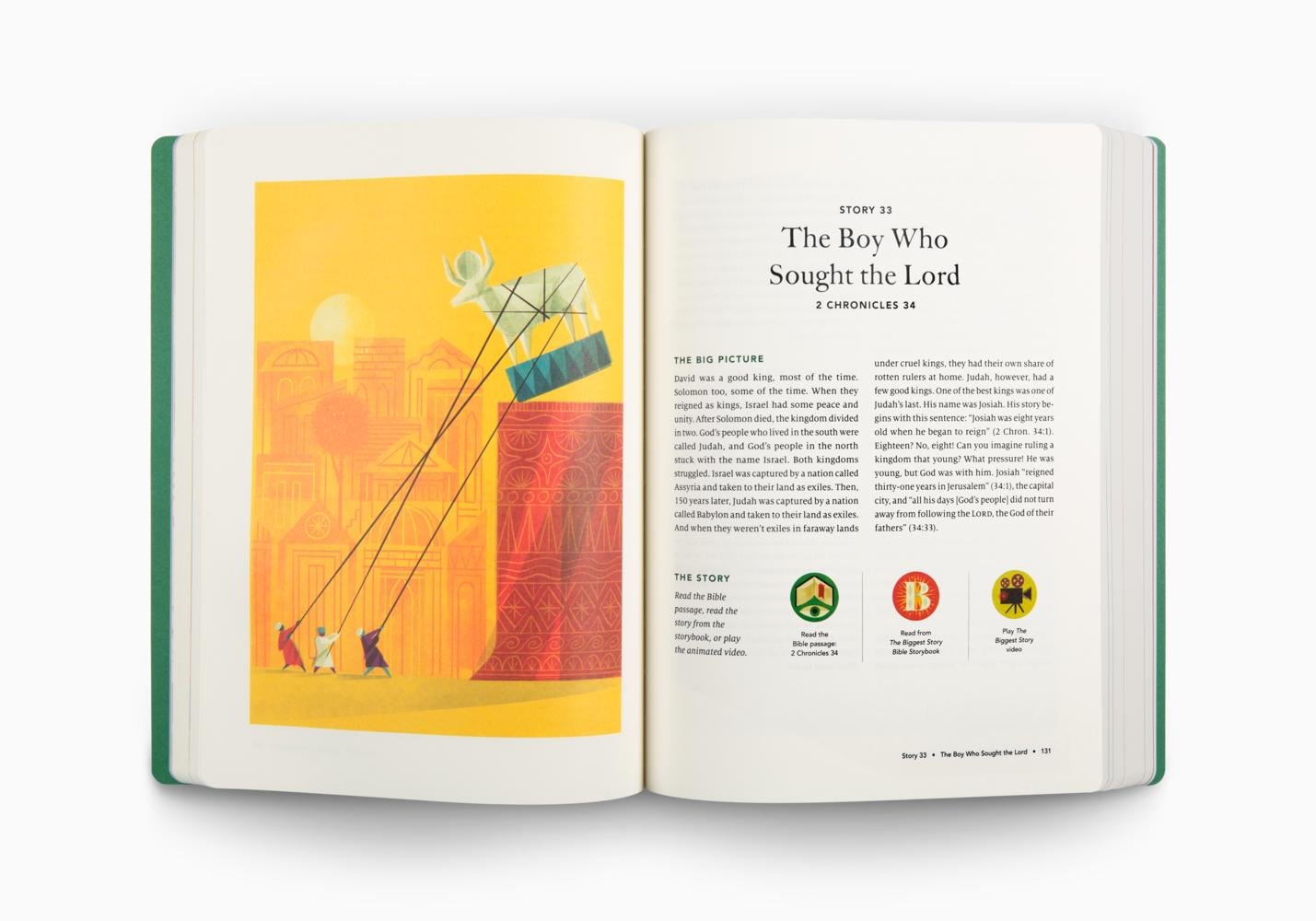
As I mentioned before, this is a supplement to Crossway’s The Biggest Story Curriculum. So if you’ve seen anything they’ve produced in that line of resources, this will immediately feel familiar. It’s got the same beautifully unique art style from Don Clark, and his work continues to be incredible here. I’m a sucker for his creative takes on characters and ideas, and the color palette he employs for each illustration makes sure my eyes take a few moments to consider the image he’s put before me. The stories and titles also line up with other entries in this line, so if you’ve already got some of those volumes on your shelf this latest release is easy to fit in as well.
Each story begins with a “Big Picture” section which helps to situate the story in the context of the larger biblical narrative. It also tends to hide an interesting hook, something to draw kids in, that gets them thinking about where the lesson might take them. It’s usually a couple of paragraphs, and it quickly whets their appetite for what’s to come.
“Regardless of where the story falls within the biblical narrative, the writers carefully connect it to the good news of the gospel. This piece of each story connects kids to the work of Jesus, his life, death, and resurrection, and invites them to see Jesus in whichever story they’re studying together.”
After that, they get directed toward the Bible story. Since this is geared toward elementary school kids, there’s a large range of reading fluency within those years to consider (not to mention attitudes day-to-day). Thankfully, they’ve got options for whatever level of reading or listening your kids are up to on a given day. They give you the actual text citation (for example, Genesis 10-11), point you to the story in The Biggest Story Bible Storybook, and give you a link to a gorgeously animated and narrated video of the story. These are all great options, and even if your kid is a great reader, I’d encourage you to rotate in the storybook and video versions as you’re plowing through each week.
From there, you get a short section that unpacks the story you just read/heard. This helps kids (and parents) nail down the details of what actually happened in the story. What are some of God’s promises to us? What promise did God make to Moses here? How did they feel when it felt like that promise wasn’t going to happen? It’s a reflection of the story to reinforce the information they learned, but it’s also interactive so that they don’t get lost in the sauce of a pile of names or plot points.
Each story wraps up with a gospel connection. If the previous section was about information, this piece is about application. Regardless of where the story falls within the biblical narrative, the writers carefully connect it to the good news of the gospel. This piece of each story connects kids to the work of Jesus, his life, death, and resurrection, and invites them to see Jesus in whichever story they’re studying together. In light of Jesus, how they they respond differently than the folks in the story? How might we pray for God’s help in a similar situation?
Finally, after they’ve worked through the story (about a page and a half in total, super doable for most elementary school kids!) there are three personal reflection questions. There’s space to answer them directly in the book (though you may want to use a journal for this if you’ve got more than one kiddo), and each question is geared toward the child connecting what they’ve just read/learned to their own lives. Questions are straightforward, and because they’re personal there’s not really a wrong answer. Parents can also use these responses as springboards to dive deeper and spark more conversations about what their kids are wrestling with.
The Verdict
There’s not really a wrong way to use this resource, except maybe letting it collect dust on a shelf. Read it to your younger kids, work through it alongside them as they become stronger readers, or let your big kids fly solo and then review their reflection answers with them once they’re finished. All in, each story should take somewhere between 10-20 minutes (videos may take longer) to roll through alongside your kid. Some weeks will spur more thought and conversation than others, and that’s okay. Trust that the Spirit is at work in them (and in you!) as you’re setting out on this journey together.
I’m a huge fan of this book. I could see this workbook being a great gift for churches to pass along to families as they start their discipleship journey with their kids, or as a family milestone once a kid learns to read. It’s incredibly easy to use, doesn’t require a Bible degree to understand, and covers a huge chunk of the biblical narrative that kids and families can explore together. The folks at Crossway have built it to facilitate conversation between kids and parents as well, which is also a huge boon for parents (no such thing as a bad conversation with your kids!).
The book itself also feels well built. It’s got nice, thick pages that are easy to write on without tearing or bleeding through. There’s plenty of margin for kids to underline and jot notes. It’s chunky enough to stand up by itself on a shelf, and the binding is strong enough that you can flatten it out to write in the reflection sections without worrying about the binding falling apart. It’s built like a big, beautiful tank (though the book nerd in me wouldn’t hate a hard cover!).
My only real complaint, and it’s a small one, is that there’s not a QR code for each story video. This is something they included with The Biggest Story Family Devotional that was super helpful as a dad with young kids a couple years ago. They drop the site in the introduction of the book, but having it at the beginning of each story would save parents some time and remove another small road block to helping them build devotional rhythms.
This is a great discipleship tool, but of course there’s not magic bullet for discipleship. We press in with love, patience, and hope, and we trust that the Spirit will show up and soften hearts (theirs and ours). That said, if you’re in the market for a discipleship resource for elementary-aged kids (and I’d argue it works for middle school too), this should be at the top of your list. It’s weekly, two-year sequence is practical and managable for just about anyone, regardless of your experience level with discipleship at home. The mix of knowledge building and heart shaping content is perfect, and if you’re willing to spend the time to engage alongside your kids as they go, you’re likely to find plenty of opportunities to talk, share, and grow with them.