
My Manhood Manifesto

Diagnosing the Problem
When a middle-aged couple came to my office for counsel in 2003, I felt completely unprepared. I was in my late twenties, in my first year of pastoring and seventh year of marriage. And they were coming to me for marriage counseling? Somehow, I struggled through, trying to ask good questions, listen well, and give helpful next steps.
These days, I’m in my early fifties and close to starting my fourth decade of marriage. Though I’m not a marriage counselor and I’m no expert, I’ve talked to countless couples since 2003. Over the years, I’ve noticed a pattern among the men who’ve sat in my office.
About 10 percent of those men were aggressive—aiming to dominate or manipulate the people and circumstances of their lives. The remaining 90 percent were passive—not sufficiently focused on the needs of the people and situations around them.
Both kinds of behavior are exemplified in the 2004 Pixar movie, The Incredibles. The aggressive man is the villain, Buddy Pine (AKA Syndrome), who works to control everyone around him, even if it hurts them. The passive man is Bob Parr (AKA Mr. Incredible), who’s preoccupied with his work and other interests. During a family meal that has descended into chaos, his wife yells, “Bob! It’s time to engage!”
The Manifesto
It’s easy to fall into either ditch, and I see both tendencies rise in my own heart. As a husband and father of a daughter and two sons, I want to avoid both manhood distortions. And I also want the same for my sons. So, over time, a sentence has begun to form. A family slogan has started to emerge. A manifesto for manhood:
We move toward people and problems in love and wisdom.
We move toward. We’re not selfishly passive, sitting back distantly and merely observing. We’re also not selfishly aggressive, moving away from situations to pursue our own interests. Instead, we take initiative and action without needing to be told.
People and problems. We don’t merely focus on what needs to be fixed, but we attend to individuals and relational dynamics as well. We also don’t focus so much on people that problems go unaddressed. We engage with both the needs and the people around us.
In love and wisdom. We don’t take initiative in resentful or passive-aggressive ways; nor do we rush in foolishly without thought or care. Our situational and relational radar is up, and it actively guides how we act and speak.
“As a husband and father of a daughter and two sons, I want to avoid both manhood distortions. And I also want the same for my sons. So, over time, a sentence has begun to form. A manifesto for manhood: We move toward people and problems in love and wisdom.”
This sentence doesn’t cover everything, and it can become overly familiar or boring—a mantra merely repeated again and again by parents. Yet it’s also been helpful for our whole family. Though I started using this manifesto with my sons, I came to see it also applies to my daughter. This made me wonder whether my family slogan had anything to do with manhood at all. I believe it does.
God’s Good Design
This week, two of our children finished their driver’s ed class. They’ve spent hours with their instructor, learning (literally) the rules of the road. They’ve been behind the wheel, practicing on back roads and on the interstate. They’ve driven on familiar and unfamiliar streets, always ending up at their selected destination. And I think that provides a helpful, if admittedly limited, analogy for thinking about raising boys to be men and girls to be women.
Think of an interstate highway, but this one has only two lanes of traffic, and they’re headed in the same direction and separated by a solid double line. According to US traffic regulations, the double line means you’re not supposed to change lanes. Still, both lanes are headed in the same direction, and they’re moving toward a common destination.
Similarly, there are God-given gender differences—distinctions both in biology and in church and family roles. A man isn’t a woman, and a woman isn’t a man. One lane is no better or worse than the other, but they’re different, not the same. So we celebrate God’s good design, and we don’t change lanes.
Yet we recognize both lanes are headed in the same direction—godly Christian maturity. That direction aims to reach a destination: each Christian boy should aim to be a godly man one day, and each Christian woman to be a godly woman one day. The right direction leads to the right destination.
So while there’s more we can say to our children about the specifics of being a grown man or woman, there’s never less than reminding them that they’re aimed toward godly, Christlike character. There are more details to learn about roles they may inhabit as adult men or women, but manhood and womanhood’s direction and destination are far more than embodying roles.
Making Mantras Work
If while they’re growing up, my two sons learn to “move toward people and problems in love and wisdom,” then when they arrive at maturity, they’ll have been on the right road. It’s not that this “manifesto” is uniquely masculine, but it will prepare our boys well for their future, unique roles of manhood. They’ll move toward Christlikeness, aiming to avoid the two ditches of aggression and passivity.
Over time, a new reality has emerged. It’s not just mom and dad who repeat this mantra. Now it’s on our children’s lips, and by God’s grace, through the years ahead, we hope it’s also in their hearts.
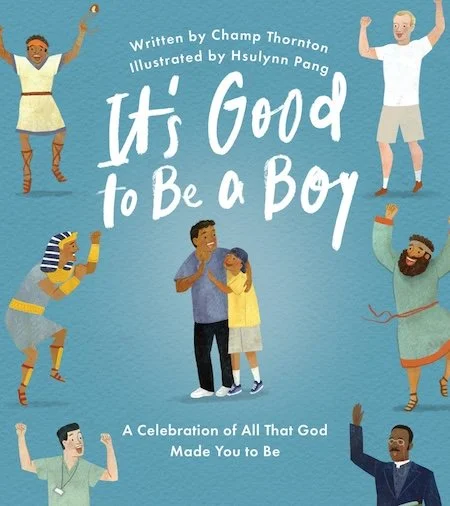
Celebrate God’s good design for boys with It’s Good to Be a Boy from Champ Thornton! Fun, upbeat, and faithful, this kids' book will excite readers with a positive vision of boyhood they’ll want to return to again and again.
Children will see that...
God gives boys strength with which to serve
men in the Bible served God in all sorts of ways
God’s design for boys brings lots of joy
The repeated, action-oriented refrain “High-five, praise God, and shout for joy, because it’s good to be a boy” will become a favorite for kids.