
Teaching Children Prayers That Transform Hearts
When We Pray, What Do We Say?
"Thank you for this day and for this food" has become the standard liturgy in our house whenever one of my three young daughters begins a prayer—even when it's bedtime and we're not eating!
The prayer typically continues with "Umm…" I open one eye, knowing I should guide them in prayer, even as I struggle to think of what to pray beyond "Bless Grandma, bless the dog, bless… Great-Grandma…"
Yet we know the sacred responsibility we have as Christian parents to teach our children to pray from the heart. We know that however simple a prayer may be, it must be sincere. And we know that the Bible—especially the Lord's Prayer—instructs us richly in how to approach God. So if you sometimes find yourself, as I do, settling into superficial prayer with your kids, I want to encourage you with a simple method that has helped my family pray with more biblical balance and sincerity.
Internalizing the Lord's Prayer Through P.R.A.Y.
We should help our children not only memorize the Lord's Prayer but internalize it by praying it in their own words.
Can a three-year-old pray, "Hallowed be thy name" in her own words, from her own heart? Yes! This is why I love the P.R.A.Y. method: praise, repent/lament, ask, and yield. It's similar to other frameworks, like A.C.T.S. (adoration, contrition, thanksgiving, and supplication), but uses simpler, kid-friendly language.
The beauty of these four elements is that they align perfectly with our Lord's model prayer:
Our Father in heaven, hallowed be your name. (Praise)
Your kingdom come, your will be done, on earth as it is in heaven. (Yield)
Give us this day our daily bread, (Ask)
and forgive us our debts, as we also have forgiven our debtors. (Repent)
And lead us not into temptation, but deliver us from evil. (Lament)
For yours is the kingdom and the power and the glory, forever. (Praise)
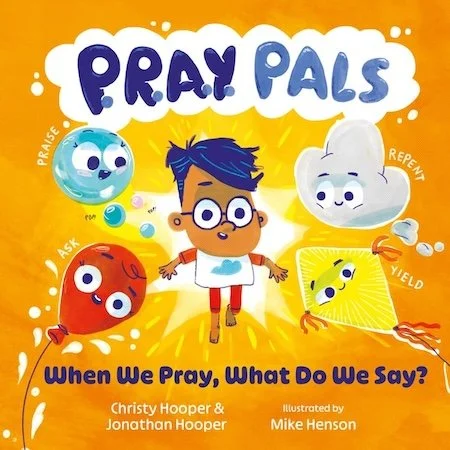
Teaching our children the substance of the Lord's Prayer is as simple as teaching them to P.R.A.Y.! When I was little, my mother created a fun character for each element:
Poppy, a joyful bubble who praises God
Rainy, a rain cloud with a soft heart who repents of sin
Airy, a curious balloon who asks God lots of things
Yessy, an adventurous kite who says yes (yields) to God’s plan
These characters—the Pray Pals, as my mom called them—have shaped the way I pray. My wife and I have introduced them to our own kids, and now, through a new picture book, we'd love to introduce the Pray Pals to your family!
How We Use the Pray Pals
When we sit down to pray as a family, especially before bed, we let our girls each choose to “be” one of the Pray Pals. Whoever is Poppy that night will open by telling God something she loves about him (praise). Whoever is Rainy will confess something they did wrong that day (repent) or share something they’re sad about and ask God to help (lament). Then the next person, being Airy, will ask God for something we need or to bless someone in need. And finally someone will yield like Yessy, acknowledging that God’s plans are best and saying yes to his will.
Unlike children’s prayer books that tend toward what I would call “greeting-card sentimentalism,” the Pray Pals invite families into real conversation with God, grounded in the gospel. They encourage even the youngest of children to speak to God in their own words, as they would to their parents, and to truly enjoy prayer.
Why P.R.A.Y.?
Here's why this P.R.A.Y. method works so well for family discipleship:
1. Everyone participates and learns that their voice matters to God.
Jonathan Edwards famously wrote that "prayer is as natural an expression of faith as breathing is of life." Just as none of us can recall our first breath, we hope our children never remember a day when they didn't enjoy a prayer-filled relationship with God.
The P.R.A.Y. method invites both participation and instruction. A word like praise is simple enough, but it may be unfamiliar to children. It's a great opportunity for parents to think through what these concepts mean and explain them in age-appropriate ways. For example, my mom taught me that praise is like "clapping for a job well done." There's more than one way to express these concepts, and you know best what will resonate with your own kids.
2. It can be adapted to different ages.
The youngest might simply praise God for taking care of us, while the oldest might praise him for specific attributes she learned about in Sunday school. When time allows, a parent can offer a more robust prayer.
This way, kids hear prayer in many forms—from the mature, biblically-rich language of their parents or church elders to the simple, heartfelt words of their younger siblings. They begin to see that what matters most to God is not how many words we pray but that our words come from the heart.
3. It ensures biblical balance, even in our simplest prayers.
Opening with praise and confession puts us in the right posture to bring our requests to God. In a therapeutic culture, it's especially important for our kids to understand that God is not a cosmic genie. They need to see from their parents what it looks like to truly praise God, confess our own sins, and cast ourselves on the mercies of Christ—and then boldly bring our needs before the King in the name of his Son.
While not every prayer needs to follow the same order exactly, having some structure frees us to pray more wholeheartedly.
4. It teaches kids the gospel and how to apply it to their lives.
The Lord’s Prayer beautifully models what it looks like to respond in faith to the gospel. In these simple, timeless petitions, Jesus isn't just teaching us how to pray—he's also showing us how to live the Christian life. To pray the elements of the Lord's Prayer is to recognize our need for a Savior, repent of sin, receive Christ as our King, rest in him for salvation, trust him to supply all our needs, and glorify him with thankful praise forevermore.
Isn't this our greatest prayer for our children—that they would believe the gospel and live a life of faith in Christ? By teaching them to pray the Lord's Prayer with sincerity, we prepare the soil of their souls and allow the Holy Spirit to work. We show forth God's glorious purpose for their lives—day in and day out—simply by helping little ones pray these elements of praise, repentance, asking, and yielding.
Not Complicated but Christ-Centered
When our children's prayers (or our own) seem simplistic and repetitive, don't be discouraged! The key truth to remember and set before our kids each day is that Jesus is the reason why we can pray. In our weakness, we send up imperfect prayers through a perfectly strong Savior, who sits in heaven as our High Priest. Through him we have bold access to the throne of grace, and for his sake the Father is pleased to receive even the simplest, sin-mingled petitions that we pray in faith.
The Pray Pals live in the sky to represent how prayers offered in Jesus' name rise up as a sweet aroma to God. Our new picture book culminates with this, my favorite stanza:
“Jesus is the one who brings / Our words to heaven’s throne. / The Father hears the smallest prayers / We pray through Christ alone.”
As we teach our children to pray—and as they often teach us about childlike faith—let's remember this: prayer that transforms hearts doesn't need to be complicated. It just needs to be Christ-centered.
Jonathan Hooper is a designer and writer with a love of theology and a heart for serving the church through technology, creativity and craft. He is the cofounder of Velora, a smart Bible app. Jonathan has served on church staffs, developed apps for notable ministries, and designed cards for American Greetings. By night, he performs as a jazz pianist. He and his wife, Lauren, have three girls and are members of a PCA congregation near Cleveland, Ohio.